



TL;DR: A Self-Funded health plan can cut fixed costs and give employers more control, but it also puts more claim risk on the employer. Stop-Loss Insurance helps with cost-control by capping exposure on large claims, protecting cash flow, and making budgets more stable.
Key takeaways
- KFF reports that 67% of covered workers in employer health plans were in Self-Funded plans in 2025.
- Self-funding is most common among large employers, where 80% of covered workers were in Self-Funded plans.
- Stop-Loss Insurance protects the employer when one claim, or total yearly claims, go above set limits.
- Some employers may see about 10% to 15% lower Premium-equivalent costs, but the right Stop-Loss level matters as much as the price.
A Self-Funded plan can feel like owning the house instead of renting it. You gain more control, and you stop paying a carrier to hold all the risk. Still, the roof can leak at the worst time.
That is why Stop-Loss coverage matters. It keeps one bad claims year from turning a smart funding move into a budget problem. The sections below show how specific and aggregate Stop-Loss work, how attachment points shape savings and risk, and why data-led Plan Design matters.
How Stop-Loss Insurance protects a Self-Funded plan from big claim shocks
In a Self-Funded plan, the employer pays medical claims as they happen. The employer may hire a Third-Party Administrator or carrier to process claims, but the money behind those claims comes from the employer’s plan funds.
Stop-Loss Insurance is the financial backstop. It does not replace the medical plan, and it does not change the member’s benefits. Instead, it protects the employer when claims pass a set threshold.
For leaders in the C-suite, Finance, and HR, that matters for three reasons. First, it limits how much a single bad year can damage cash flow. Second, it supports steadier budgeting. Third, it helps keep a benefits strategy on track when high-cost cases appear.
One premature birth, cancer diagnosis, or transplant can shift plan costs fast. Without Stop-Loss, those events hit the employer’s balance sheet in full. With it, the plan has guardrails.
Stop-Loss protects the employer from claim volatility. It does not replace the health plan employees use.
Specific Stop-Loss puts a cap on one person’s large claim
Specific Stop-Loss applies to one member’s claims. The employer chooses a Deductible, often called the specific attachment point. Once that member’s claims rise above the Deductible, the Stop-Loss carrier reimburses eligible amounts above that level, based on policy terms.
Say an employer has a $50,000 specific Deductible. One member then has a $550,000 claim. The employer is responsible for the first $50,000. After that, the Stop-Loss policy may reimburse the remaining $500,000, assuming the claim meets the contract terms.
That example shows why Stop-Loss is central to cost-control. One person’s large claim can change the whole Plan Year. It can also affect reserves, renewal discussions, and leadership confidence in self-funding.
Aggregate Stop-Loss protects the plan when total claims run high
Aggregate Stop-Loss is the second layer. Instead of focusing on one person, it protects the plan when total claims for the year rise above a set ceiling.
This matters when no single claim is catastrophic, yet the group still has a rough year. Maybe there are more surgeries than expected. Maybe a few moderate claims stack up at once. In that case, aggregate Stop-Loss limits the employer’s total yearly exposure.
For Finance teams, this helps at year-end. For HR, it reduces the risk that a poor claims year forces sudden plan changes. For executive leaders, it supports more predictable financial outcomes.
Where the savings come from, and why the right Stop-Loss level matters
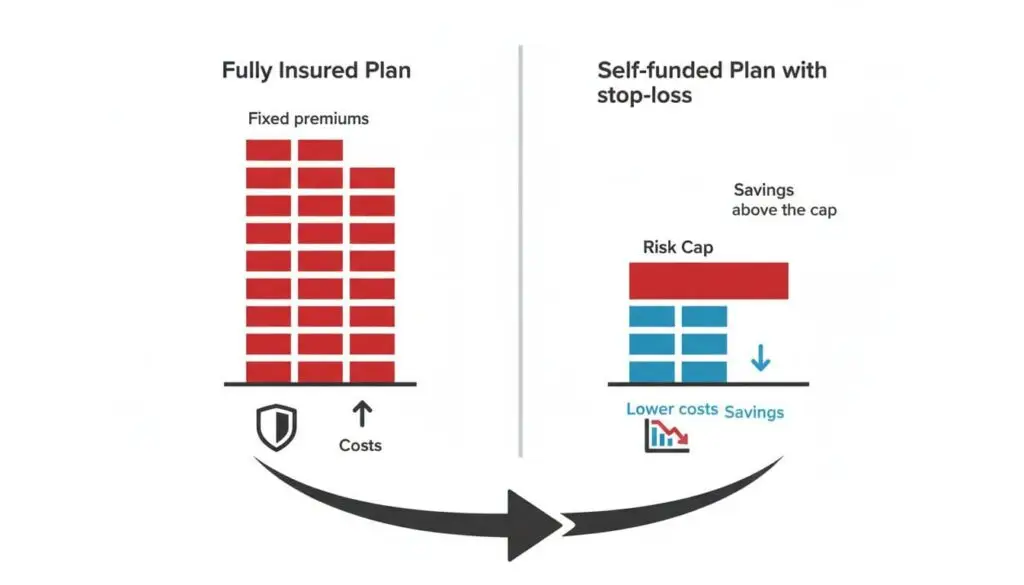
Self-Funded employers often lower fixed costs because they pay claims directly and buy Stop-Loss protection, rather than paying a carrier to absorb all routine risk. In the right situation, that can produce real savings.
Some employers see roughly 10% to 15% lower Premium-equivalent costs than they would under a fully insured model. Those savings are not automatic. They depend on group size, claims history, funding method, and the Stop-Loss contract itself.
Large employers often use this model because the economics are stronger at scale. KFF’s 2025 survey found that 67% of covered workers were in Self-Funded plans, and the share rose to 80% at large firms. That tells a simple story. Employers continue to choose self-funding for control, but they do so with risk protection in place.
Lower fixed costs can help, but risk has to match your cash flow
A lower Stop-Loss Premium can look attractive. Yet cheaper is not always better.
Higher attachment points usually reduce the monthly Stop-Loss cost. At the same time, they push more claim risk back to the employer. That may work for a company with strong reserves and a high tolerance for swings. It may be a poor fit for a business that needs tighter cash flow control.
This quick comparison shows the tradeoff:
| Attachment point | Monthly Stop-Loss cost | Employer claim risk | Budget stability |
|---|---|---|---|
| Lower Deductible | Higher | Lower | Stronger |
| Higher Deductible | Lower | Higher | Weaker |
The best choice depends on your balance sheet, not on Premium alone. Finance leaders should weigh reserves, year-to-year volatility, and renewal risk before locking in terms. Employers that want a more predictable monthly funding pattern sometimes review level funding for predictable budgeting as part of that discussion.
Good cost-control starts with claims data, not guesswork
Strong Stop-Loss decisions come from claims analytics, actuarial review, and clean benchmarking. A plan should fit the population it covers, not a generic market average.
That means studying large claim history, pharmacy trends, utilization patterns, and the age and risk mix of the group. It also means looking at how often claims cross likely Deductible levels. If the data shows frequent claims near a proposed threshold, the structure may need work.
JA approaches this as a long-Term strategy, not a quick purchase. Clear data helps leaders see where the plan is performing, where costs are drifting, and where risk protection should sit. Good analysis also gives HR and Finance a common view of the same facts, which leads to better decisions and more measurable outcomes.

The goal is larger than buying protection. The goal is to design a smarter Self-Funded plan, one that matches real member needs, supports budget discipline, and improves ROR over time.
What a smart Stop-Loss strategy looks like for employers
A sound Stop-Loss strategy starts with listening. Leadership may care most about budget risk. HR may care most about plan stability and employee trust. Finance may focus on cash flow and claim timing. A good partner hears all three.
Next comes assessment. Current plan funding, past large claims, renewal terms, exclusions, and reimbursement patterns all matter. Then the strategy can be built around the employer’s real needs, not a template.
Clear communication is also part of cost-control. If leaders do not understand the contract, they may think they have protection they do not actually have. Strong execution matters too, because reimbursement delays, hidden exclusions, or poor renewal terms can erase expected savings.
A real example, avoiding a $500,000 claim hit
An employer with solid Stop-Loss protection avoided taking the full impact of a $500,000 claim. That did not make the claim disappear, but it did keep the plan from absorbing the full financial blow.
That kind of protection helps in two ways. It shields the balance sheet in the short Term, and it protects the larger benefits strategy in the long Term. When a major claim does not drain reserves, employers are in a better position to keep funding benefits with confidence.
Questions to ask before choosing Stop-Loss coverage
Before choosing a Stop-Loss structure, decision-makers should slow down and ask direct questions:
- What specific and aggregate limits fit our risk tolerance and cash reserves?
- How fast does the carrier reimburse eligible claims?
- Are any lasers, exclusions, or contract limits applied to known high-risk members?
- How could renewal terms change next year’s budget?
- What do our claims patterns suggest about the right attachment points?
- How does our employee population affect risk, especially pharmacy and high-cost care trends?
Those questions keep the discussion grounded in facts. They also move the focus from price alone to the full picture of protection, stability, and measurable outcomes.
Stop-Loss Insurance is a core part of cost-control in a Self-Funded plan because it limits exposure to large claims while preserving the flexibility that makes self-funding attractive. The right structure depends on data, risk tolerance, and a plan for more than one renewal cycle.
That is where JA adds value as a partner. With clear insight, practical analysis, and accountability in execution, JA helps employers build a future-focused plan that protects against costly surprises while supporting savings that last.


